

Pre-Clinical Evidence: Engineered to Reduce Subsidence
Our optimization technology has been tested through pre-clinical studies: computational modelling, biomechanical testing, and peer-review. Pre-clinical data demonstrates consistent subsidence risk reduction*,***.
Peer-Reviewed Scientific Validation
OptimalPSI's approach to subsidence reduction has been tested through pre-clinical peer-reviewed research published in leading biomechanical engineering journals. Two studies, one based on computational modeling and the other on physical biomechanical testing, provided converging evidence of substantial performance improvements over existing solutions.
Computational Modeling Study
In-silico medical device testing of anatomically and mechanically conforming patient-specific spinal fusion cages designed by full-scale topology optimization
Smit, T., Aage, N., Haschtmann, D., Ferguson, S. J., and Helgason, B. (2024). Frontiers in Bioengineering and Biotechnology, 12, 1347961.
What it shows: Computational validation demonstrates that optimization addresses the fundamental mechanical problem causing subsidence, not just improving anatomical fit. Authors include OptimalPSI employees and compensated advisors. See publication for full conflict-of-interest disclosures.
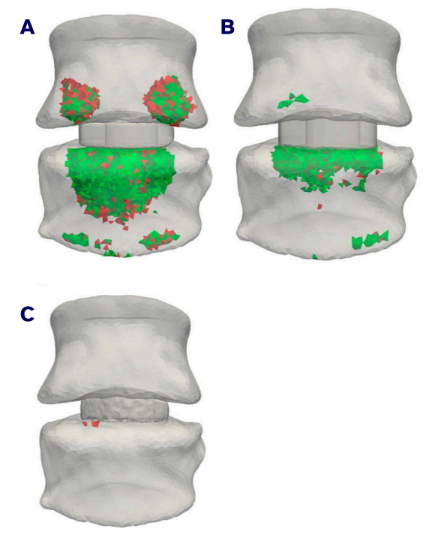
Overloaded bony structures are highlighted in green for PEEK and red for Titanium. A Off-the-shelf implant. B Anatomy-only patient-specific implant. C Patient-specific optimized implant (OptimalPSI)
Access Publication →Biomechanical Testing Study
Ex-vivo mechanical evaluation of anatomically and mechanically conforming patient-specific spinal fusion cages designed by full-scale topology optimization
Du, X., Smit, T., Rubin, W., Cheruparambil, C., Shah, R., Haschtmann, D., Helgason, B., Ferguson, S. J.
What it shows: Experimental testing confirms that computational predictions translate to physical mechanical performance. Authors include OptimalPSI employees and compensated advisors. See publication for full conflict-of-interest disclosures.
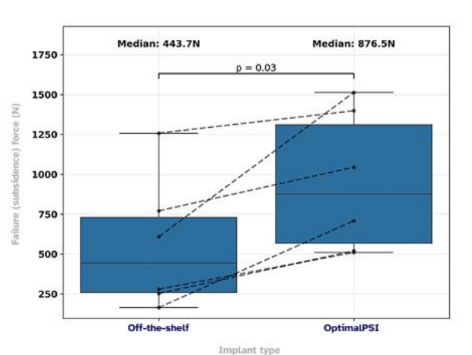
Mechanical testing results summarized. Failure (subsidence force) vs. implant type, off-the-shelf and OptimalPSI.
Access Publication →
Scientific Foundation: ETH Zürich Research Collaboration
OptimalPSI's optimization approach emerged from doctoral research at ETH Zürich's Laboratory for Orthopaedic Technology under Prof. Stephen Ferguson, conducted in collaboration with spine surgeon PD Dr. med. Daniel Haschtmann at Schulthess Klinik. This academic foundation ensures that our technology is grounded in rigorous biomechanical principles and validated through established research methodologies.
Learn About Our Team →