Pre-Clinical Evidence: Engineered to Reduce Subsidence

Our optimization technology has been rigorously validated through computational modeling, biomechanical testing, and peer-review. Pre-clinical data demonstrates consistent subsidence risk reduction across a wide range of bone quality*,***.

Off-the-shelf OptimalPSI

Peer-Reviewed Scientific Validation

OptimalPSI's approach to subsidence reduction has been validated through peer-reviewed research published in leading biomechanical engineering journals. Two independent studies, one based on computational modeling and the other on physical biomechanical testing, provided converging evidence of substantial performance improvements over existing solutions.

Module 1 · Computational Modeling Study

Computational Modeling Study

In-silico medical device testing of anatomically and mechanically conforming patient-specific spinal fusion cages designed by full-scale topology optimization

Smit, T., Aage, N., Haschtmann, D., Ferguson, S. J., and Helgason, B. (2024). Frontiers in Bioengineering and Biotechnology, 12, 1347961.

Study design: In-silico finite element analysis on patient cohort with varying bone quality levels
Key findings
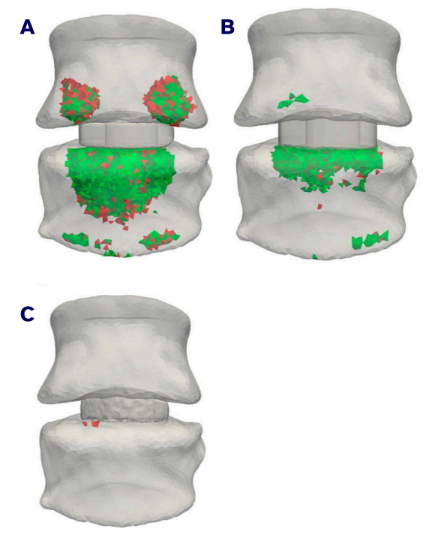
89% median subsidence risk reduction with titanium implants vs. off-the-shelf implants
94% median subsidence risk reduction with PEEK implants vs. off-the-shelf implants
75% reduction vs. anatomy-only patient-specific solutions

Clinical significance: Computational validation demonstrates that optimization addresses the fundamental mechanical problem causing subsidence, not just improving anatomical fit.

Overloaded bony structures comparison across implant types

Overloaded bony structures are highlighted in green for PEEK and red for Titanium. A Off-the-shelf implant. B Anatomy-only patient-specific implant. C Patient-specific optimized implant (OptimalPSI)

Access Publication →
Module 2 · Biomechanical Testing Study

Biomechanical Testing Study

Ex-vivo mechanical evaluation of anatomically and mechanically conforming patient-specific spinal fusion cages designed by full-scale topology optimization

Du, X., Smit, T., Rubin, W., Cheruparambil, C., Shah, R., Haschtmann, D., Helgason, B., Ferguson, S. J.

Study design: Ex-vivo mechanical testing using human cadaveric specimens
Key findings
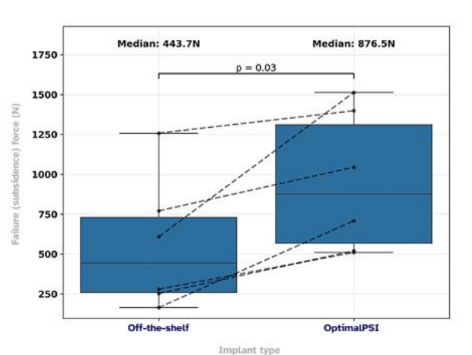
~2x higher resistance to subsidence vs. off-the-shelf implants
Statistically significant performance (p = 0.03)

Clinical significance: Independent validation confirms that computational predictions translate to physical mechanical performance.

Failure force comparison: off-the-shelf vs OptimalPSI

Mechanical testing results summarized. Failure (subsidence force) vs. implant type, off-the-shelf and OptimalPSI.

Access Publication →

Subsidence Reduction Across Wide Range of Bone Quality Levels

Off-the-shelf implants show significantly worse outcomes in osteoporotic patients1,2. OptimalPSI's optimization aims to deliver meaningful subsidence reduction across the entire patient spectrum, with particularly strong performance in the high-risk population that needs it most.

The range reflects OptimalPSI's adaptive optimization, the algorithm adjusts implant design based on each patient's bone structure, maintaining substantial subsidence reduction.

Subsidence risk reduction vs. off-the-shelf implants in pre-clinical computational modeling*,**
91%
median reduction — normal bone quality patients
89–94%
median reduction — overall patient cohort
Why this matters

Many surgeons hesitate to perform TLIF procedures on high-risk patients due to high subsidence rates with off-the-shelf implants. OptimalPSI's consistent performance, as demonstrated in pre-clinical testing, may expand treatment options for an underserved patient population with limited alternatives.

FDA-Recognized Validation Pathway

OptimalPSI follows established medical device validation protocols, progressing systematically from computational analysis through physical testing to ensure our technology delivers on its clinical promise.

Completed 2024
Phase 1: In-Silico Computational Modeling

Computational modeling optimizes implant design for patient-specific fit and mechanics.

Completed 2025
Phase 2: Human Cadaveric Testing

Physical testing validates computational predictions and informs final design specifications.

Want to discuss how this validation approach applies to your clinical practice or investment thesis?

Schedule Consultation →
OptimalPSI research team in the lab
Founder credibility

Scientific Foundation: ETH Zürich Research Collaboration

OptimalPSI's optimization approach emerged from doctoral research at ETH Zürich's Laboratory for Orthopaedic Technology under Prof. Stephen Ferguson, conducted in collaboration with spine surgeon PD Dr. med. Daniel Haschtmann at Schulthess Klinik. This academic foundation ensures that our technology is grounded in rigorous biomechanical principles and validated through established research methodologies.

Learn About Our Team →

Why This Evidence Matters: Real Clinical Impact

Subsidence isn't just a radiographic finding, it causes persistent pain, reduces fusion success, and in worst cases, can lead to revision surgery. With off-the-shelf cages affecting 51% of patients3, preventing subsidence addresses the primary driver of poor outcomes and patient dissatisfaction.

OptimalPSI's patient-specific TLIF implant could transform outcomes for your patients, especially those who face the highest failure rates with standard implants.

Schedule a Clinical Consultation

Discuss how OptimalPSI's validated subsidence reduction technology could benefit your high-risk patient population.

Schedule Consultation →

Schedule an Investor Meeting

Review our de-risked regulatory pathway, validated technology, and market opportunity in detail.

Schedule Investor Meeting →